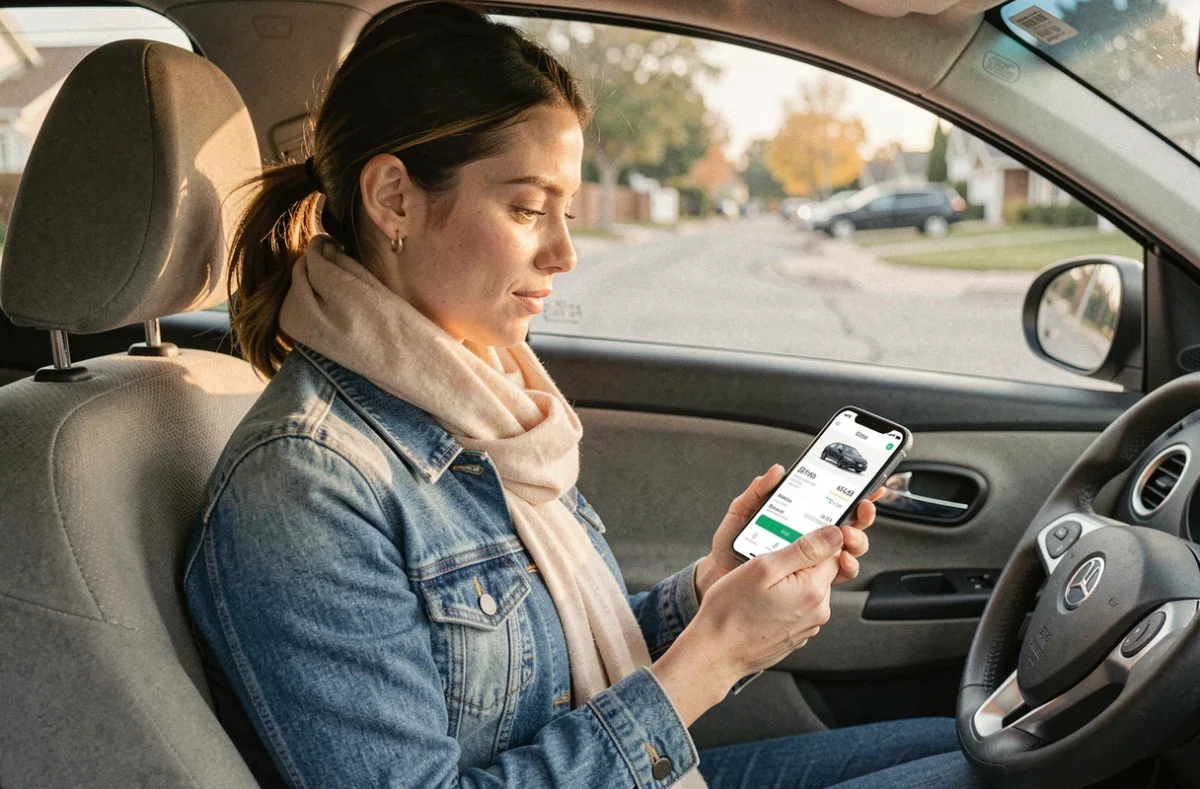
BlaBlaCar boasts over 100 million members and remains the leading carpooling platform in France. Behind this popularity, the question of BlaBlaCar carpooling fees arises with every booking: how much does the platform take, how is the price of a trip calculated, and does the passenger really pay a fair rate compared to the actual cost of the journey?
How BlaBlaCar calculates the price of a carpooling trip
The driver sets the amount of the contribution requested from passengers. BlaBlaCar provides a recommended price range, calculated based on the distance of the trip, fuel prices, and any tolls.
This range is merely indicative. The driver can adjust the fare up or down, within the limits set by the platform. French law (Article L. 3132-1 of the transport code) prohibits any remuneration: the driver can only share travel costs, not profit from them.
Prices displayed on BlaBlaCar also vary according to the date, time, and demand. The platform indicates “starting from” rates and averages based on recent confirmed trips, which explains the discrepancies observed from one day to the next for the same route. A trip booked on a weekday during off-peak hours will not cost the same as a departure on Friday evening, as explained by the BlaBlaCar fees explained on Autoscope in their detailed analysis.
BlaBlaCar Commission: what the platform takes from each booking
BlaBlaCar applies service fees on each booking made through the platform. These fees are charged to the passenger, in addition to the price set by the driver. The driver receives the amount they defined, without any direct deduction from their share.
The passenger always pays more than the amount displayed by the driver. The commission covers the operation of the platform, the online payment system, and the insurance related to the booking. Its amount varies according to the price of the trip but represents a significant portion on short trips where the base contribution is low.
This mechanism sometimes creates a noticeable gap. On a trip with a low contribution, service fees can represent a high proportion of the total price paid. On long distances, this ratio decreases, making carpooling more competitive compared to trains or buses.
Payment and transfer to the driver
Payment is made online at the time of booking. BlaBlaCar holds the amount and only transfers it to the driver after the trip has actually taken place. This system protects the passenger in case of cancellation but involves a delay in receipt for the driver.
In case of cancellation by the passenger, the refund conditions depend on the time before departure. The later the cancellation, the higher the penalty. If the driver cancels, the passenger is fully refunded.
BlaBlaCar Daily and local subsidies: a different pricing model
Short-distance carpooling via BlaBlaCar Daily operates under a pricing model distinct from traditional long-distance carpooling. The main difference lies in the involvement of local authorities, which directly subsidize home-to-work trips.
In Liffré-Cormier, a scheme launched on September 30, 2024, is based on automatically proposed meeting points and a driver compensation calculated based on the distance traveled. In the Leff Armor Community area, the driver receives between 1.50 and 8 euros per trip, while the passenger contributes 0.50 euros for trips of less than 40 km.
This type of scheme radically changes the actual cost borne by users. The passenger pays a symbolic contribution, the driver receives compensation greater than what the passenger’s contribution alone would allow, and the community funds the difference.
- Long-distance carpooling relies on a free price set by the driver, with BlaBlaCar commission charged to the passenger.
- BlaBlaCar Daily incorporates local subsidies that reduce the passenger’s contribution and increase the driver’s compensation.
- Subsidies vary significantly from one area to another: some communities also offer a sustainable mobility package that can be combined with carpooling.
BlaBlaCar carpooling fees compared to trains and buses: the real price gap
Carpooling on BlaBlaCar is generally presented as significantly cheaper than the train. The data available on the platform confirms a significant gap on long distances, but this price advantage deserves to be nuanced.
The displayed price does not reflect the full cost for the passenger. One must add the BlaBlaCar service fees, the often longer travel time compared to TGV, and the lack of strict hourly guarantees. A driver may be late, change their departure point, or cancel their trip.
For the driver, the calculation is different. The contributions from passengers help cover part of the fuel and toll costs, but never cover vehicle wear and tear or insurance. Carpooling remains a cost-sharing arrangement, not a source of income.
Availability and reliability of trips
Availability is a limiting factor that is rarely mentioned. On some less frequented routes, carpooling offers are rare or nonexistent. Field reports vary on this point: major routes (Paris-Lyon, Paris-Bordeaux) offer a wide choice, while trips between medium-sized cities remain unpredictable.
- On major routes, BlaBlaCar carpooling offers several daily departures with competitive rates.
- On secondary routes, the offer entirely depends on willing drivers, with no guaranteed regularity.
- Buses and trains remain more reliable in terms of schedules and availability.
The choice between carpooling, bus, and train ultimately depends less on the gross price than on the combination of fare, travel time, and reliability. On a Paris-Lyon route, carpooling can cost three times less than the full-price TGV, but the journey takes longer and involves a degree of uncertainty that rail does not impose.