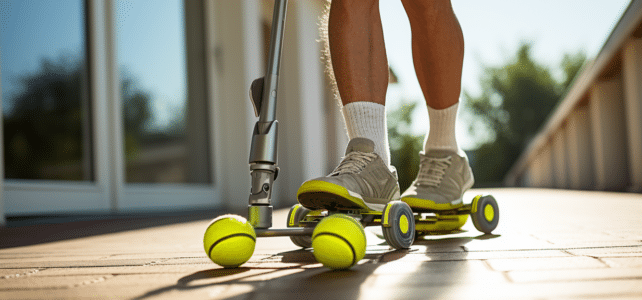
The adaptation of tennis balls on the feet of a walker is not just a familiar sight in nursing homes and rehabilitation centers; it is a clever solution that combines functionality and economy. These yellow spheres provide better stability on various surfaces, reducing the risk of slipping thanks to their rubbery texture that grips the ground. They allow for smooth and gentle traction, making it easier for the user to maneuver the walker. It is a cost-effective option, favorably replacing specialized tips that are often expensive and less effective. This simple trick significantly enhances the experience of people with reduced mobility.
Discover why tennis balls are used on walkers to improve stability
Improving stability and traction with tennis balls on walkers
Discover why tennis balls are used on walkers to improve stability. This practice, seemingly innocuous at first glance, is based on principles of basic physics: increasing the contact area between the walker and the ground. Once attached to the feet of walkers, tennis balls reduce the pressure exerted on each contact point, thereby decreasing the risk of slipping and falling for the user.
Traction is another major concern for walker users. Tennis balls, with their rubber coating, provide superior grip on various surfaces, including tile and concrete, which are commonly encountered in the daily environments of seniors. This results in smoother and more controlled movement of the walker, thus avoiding potentially dangerous snags.
Compared to traditional rubber tips, tennis balls prove to be a more effective solution, as evidenced by the relationships and comparisons established by experts. Their ability to enhance both stability and traction of walkers without compromising user comfort is widely recognized, making tennis balls a preferred choice in improving mobility.
The increased safety provided by the use of tennis balls on walkers extends beyond stability and traction. Their bright color also contributes to better visibility of the device, a significant advantage in preventing accidents in shared spaces. Tennis balls are a simple yet profoundly effective addition to transform the daily lives of those reliant on a walker.

The economic benefits of using tennis balls on walkers
Beyond practical benefits, the use of tennis balls on walkers presents notable economic advantages. They are significantly less expensive than specialized tips sold commercially, allowing users to make substantial savings without compromising the quality or safety of their equipment. The high durability of tennis balls allows for less frequent replacements of rubber tips, thereby reducing recurring expenses related to walker maintenance.
The shock absorption provided by tennis balls also plays an economic role. Indeed, this method reduces wear and tear on walkers by evenly distributing loads and absorbing shocks during movement. As a result, the longevity of the devices is improved, delaying the need to invest in new medical equipment, which is often costly. This long-term saving is particularly significant for healthcare institutions managing a large inventory of equipment.
The postural improvement induced by the use of tennis balls can reduce healthcare costs. Indeed, better posture limits the risks of musculoskeletal disorders, potentially leading to fewer visits to healthcare professionals and a decrease in medication consumption. Beyond a simple trick, the use of tennis balls on walkers proves to be a wise choice, both for comfort and safety as well as for cost management in the healthcare sector.